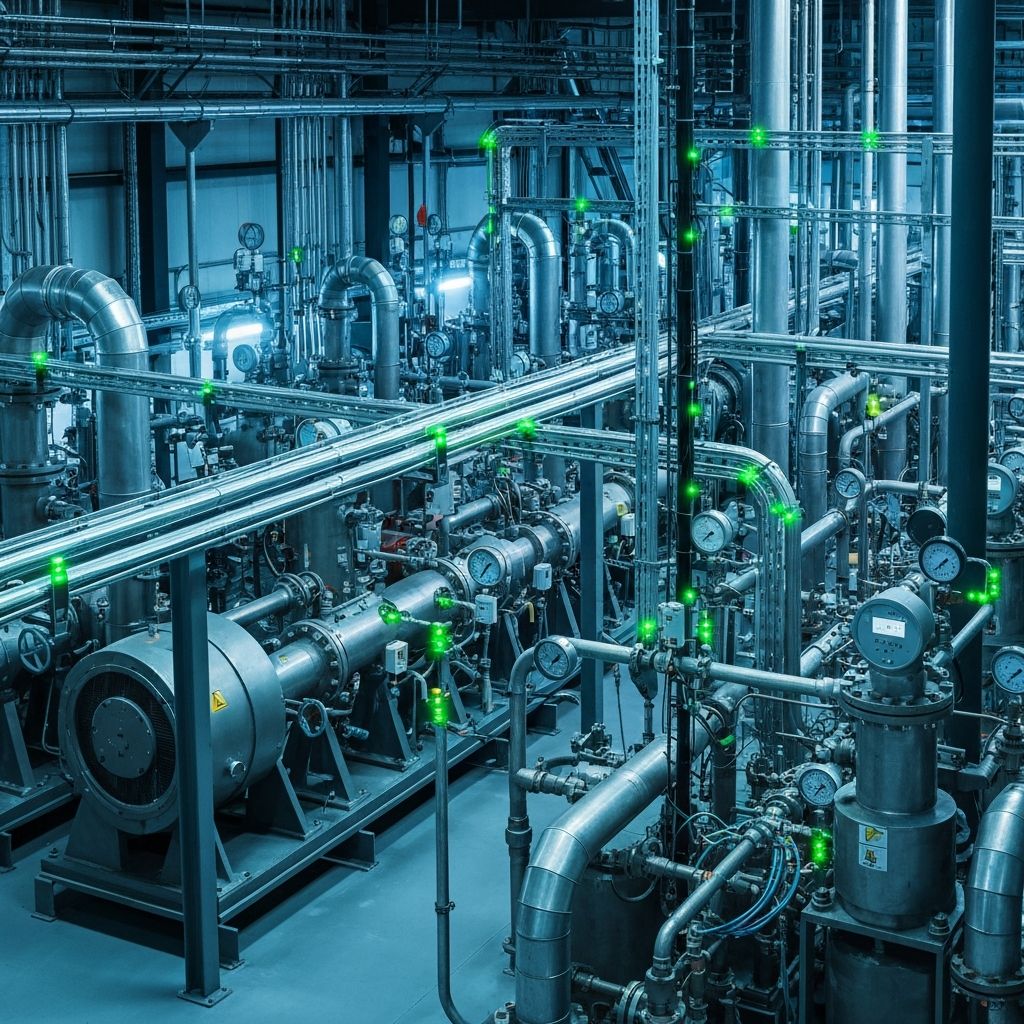
Industrial energy monitoring delivers the fastest return on investment of any IoT use case because the economics are straightforward: you are measuring a cost you already pay, identifying waste that already exists, and eliminating it with operational changes that require no capital expenditure beyond the sensors themselves. Typical deployments achieve 10-15% energy reduction within the first six months of operation. For a facility spending $2M annually on energy, that is $200K-$300K in savings against a deployment cost of $80K-$120K — a payback period of five months or less.
The sensor layer is where most teams over-engineer. For energy monitoring, you need current transformers (CTs) on electrical panels, not on individual machines. A 50-panel facility requires approximately 150-200 CT sensors at $40-$80 each, plus edge gateways at $500-$1,500 each (one per 20-30 sensors). Total hardware cost for a mid-size manufacturing facility: $15K-$30K. Compare this to the cost of manual energy audits ($20K-$50K annually for a qualified engineer) that produce static snapshots rather than continuous insight. The sensor deployment pays for itself by eliminating the audit cost alone, before you capture any savings.
AWS IoT Core handles device connectivity and message routing at scale. Each sensor gateway publishes energy readings via MQTT every 15-60 seconds — frequent enough to detect anomalies, infrequent enough to keep data transfer costs under $50/month for a typical facility. IoT Core's rules engine routes messages to downstream services without custom code: high-priority alerts go to SNS for immediate notification, all readings flow to the time-series database for analysis. Authentication uses X.509 certificates per device, providing the security posture that your IT team requires without the operational overhead of credential rotation.
AWS IoT Greengrass runs on your edge gateways, providing local compute for two critical functions: data aggregation (reducing cloud transfer costs by 60-80% through local averaging) and offline resilience (buffering readings during network outages and forwarding when connectivity returns). For a manufacturing facility, network reliability is never 100% — Greengrass ensures you never lose data during the outages that inevitably occur. It also enables local alerting: if a motor draws 3x its normal current, the alert fires in milliseconds from the edge, not seconds from the cloud.
Amazon Timestream is purpose-built for IoT time-series data and costs 80-90% less than running a relational database for the same workload. A typical energy monitoring deployment generates 5-10 million data points per day per facility. In Timestream, this costs approximately $30-$50/month for storage and $100-$200/month for queries, depending on dashboard refresh frequency. The memory store handles recent data (last 24 hours) for real-time dashboards, while the magnetic store retains historical data for trend analysis at a fraction of the cost. Retention policies automatically manage the lifecycle.
AI Readiness Checklist
Assess whether your enterprise is ready for production AI — the same framework we use in discovery calls.
The data pipeline from raw sensor readings to actionable insight uses AWS Glue for transformation and enrichment. Raw readings need context: which production line was running, what was the ambient temperature, what shift was operating. Glue ETL jobs join sensor data with production schedules and weather data to produce normalised energy-per-unit metrics. This normalisation is critical — without it, you cannot distinguish between increased energy use due to higher production volume (acceptable) and increased energy use due to equipment degradation (actionable). Schedule Glue jobs hourly for operational dashboards and daily for executive reporting.
Amazon QuickSight delivers the visualisation layer that drives behaviour change. Build three dashboard tiers: executive (monthly cost trends, facility comparisons, ROI tracking), operations manager (daily consumption by zone, anomaly alerts, shift comparisons), and maintenance (equipment-level trends, degradation indicators, predictive alerts). The critical insight is that dashboards alone do not save energy — they enable conversations. When an operations manager can see that Line 3 consumes 40% more energy per unit than Line 2 during the same product run, they investigate. That investigation finds the root cause. The dashboard made the question visible.
Calculate your ROI before deployment using this framework: take your annual energy spend, multiply by your facility's estimated waste percentage (12-18% is typical for facilities without continuous monitoring), and multiply by your expected capture rate (60-70% of identified waste is addressable through operational changes alone). That gives you annual savings. Divide your deployment cost (hardware + installation + first-year cloud services + integration labour) by monthly savings to get payback in months. If the number is above eight months, your scope is too large — reduce to a single facility or zone and prove value before expanding.
Installation follows a three-phase pattern. Phase one (weeks 1-3): install CTs on main distribution panels and subpanels, deploy gateways, validate data flow to cloud. Phase two (weeks 4-8): establish baselines, configure anomaly detection thresholds, build initial dashboards, train operations staff. Phase three (weeks 9-20): identify and implement operational changes, measure savings against baseline, document results for executive reporting. The most common mistake is extending phase one by attempting to instrument individual machines — start at the panel level, identify which circuits show the most waste, then add granularity only where the data justifies it.
Ongoing monitoring costs are predictable and low. AWS service costs for a single facility typically run $200-$400/month (IoT Core messaging, Timestream storage and queries, Glue jobs, QuickSight licenses). Add $50-$100/month for sensor battery replacements and gateway maintenance. Total annual operating cost: $3K-$6K per facility. Compare this to the $200K-$300K in annual savings for a $2M energy spend facility. The ratio of operating cost to savings (1:50 to 1:100) makes this one of the most defensible technology investments available to a manufacturing CTO.
Scaling from one facility to many is where the architecture pays dividends. Each additional facility adds sensors and gateways but shares the same cloud infrastructure — Timestream, Glue jobs, and QuickSight dashboards accommodate multi-facility data with configuration changes, not re-architecture. The marginal cost of adding a facility is hardware plus installation labour, with minimal incremental cloud cost. Most organisations reach three to five facilities within 18 months of their first deployment, driven by the undeniable ROI evidence from the pilot site.
Want to discuss these ideas?
We're always happy to talk shop about cloud, AI, and what it takes to move from pilot to production.